
Sunblock and sunscreen are the same thing
The two words describe the same category of product. Sunblock is the older term and the one used almost universally in Pakistan; sunscreen is what the labels and the formulation industry say. Neither tells you anything about how good the product is.
What separates products is the filter system, the stated SPF, the UVA rating and the texture — not which of the two words is printed on the front. Ignore the word and read the two ratings below.
SPF and PA are two different ratings
SPF measures protection against UVB, which causes burning. PA, written as PA+ to PA++++, measures protection against UVA, which causes pigmentation and ageing and passes through cloud and glass. For Pakistan, broad-spectrum SPF 50 every morning, with PA+++ or higher.
A high SPF with a weak or unstated UVA rating is the common gap. On brown skin, burning is less often the visible problem than tanning and pigmentation, and those are UVA. If a label states only SPF, it is telling you half the story.
What Pakistani sunblocks actually disclose
Almost none of them state a PA rating, and most state no size either. Of the sunblocks checked on the Pakistani market, one named its UV filters and one gave a PA rating. That means UVA protection, the half of the sun that drives pigmentation and ageing, cannot be verified on most of this shelf at any price.
Read the SPF 100 row before anything else. SPF 100 sold for half the price of the same brand's SPF 50 is not a better product, and the number is close to meaningless at that end — SPF 50 blocks about 98% of UVB and SPF 100 about 99%, a difference smaller than the gap between applying enough and applying the quarter-dose most people use. Nothing in a high SPF number tells you about UVA at all. The practical rule for Pakistan is unglamorous. Buy broad-spectrum SPF 50 from a product that states a PA rating or names its filters if you can find one, buy something you will actually reapply if you cannot, and put on more than feels reasonable. A sunblock you wear at the full amount beats a better one you use sparingly.
Swipe the table sideways to see every column.
| Sunblock | What the label states | Price |
|---|---|---|
| Neue Sunscreen SPF 50 | SPF 50, PA+++, 70 ml. Octocrylene and avobenzone both named. The only Pakistani product checked that states its filters | Rs. 1,899, Rs. 27.1 per ml |
| Jenpharm Spectra Matt SC SPF 50 | SPF 50, for oily and acne-prone skin. No PA rating, no size, no filters stated | Rs. 1,798 |
| Jenpharm Spectra Block SPF 60 | SPF 60, for normal and combination skin. No PA rating, no size, no filters stated | Rs. 898 |
| Jenpharm Spectra Block Max 100 | SPF 100, slightly tinted. No PA rating, no size, no filters stated. Half the price of the same brand's SPF 50 | Rs. 898 |
| Oneskin Clear Guard Gel SPF 50++ | SPF 50, gel. No size or filters stated, and the two plus signs are not standard PA notation | Rs. 1,750 |
| Beauty of Joseon Relief Sun and other imported lines | SPF 50+, PA++++, 50 ml. Full UVA rating stated. Imported through resellers, so storage varies by seller | Rs. 5,200 to Rs. 5,865 imported |
Mineral, chemical and hybrid
Mineral filters — zinc oxide and titanium dioxide — sit on the surface, suit sensitive and reactive skin, and can leave a white cast. Chemical filters absorb UV, are cosmetically lighter, and suit deeper skin tones better. Neither is safer than the other for ordinary use.
Modern hybrid formulas combine both and are usually the best compromise for Pakistani skin tones — enough zinc for stability, enough organic filter to avoid a grey cast. The right choice is heavily personal, because the only sunscreen that works is the one you will apply every day.
The white cast problem
Zinc oxide is white and stays white on skin. On medium to deep brown skin a heavily mineral formula reads grey or ashy, which is the single most common reason people stop wearing sunscreen here.
Tinted mineral sunscreens solve this well and are worth the extra cost if a clear formula irritates you. Otherwise a modern chemical or hybrid formula will disappear on brown skin without any tint.
How much to apply, which is more than you think
Roughly a quarter to a third of a teaspoon for the face alone, or the two-finger length rule — a strip along the length of your index and middle fingers. Most people apply a quarter of the tested amount and get a fraction of the stated SPF.
Under-application is why an SPF 50 often performs like an SPF 10 in real life. If a bottle lasts you six months of daily use, you are not using enough. A face-only sunscreen used correctly should run out in roughly two months.
Reapplication, and the practical formats for it
Every two to three hours outdoors and after heavy sweating. A stick, a powder or a cushion compact is the realistic way to reapply over makeup or during a working day.
If you are indoors away from windows all day, one morning application is broadly fine. If you commute, sit by a window, or step out at lunch, plan for at least one reapplication.
Sunscreen for oily and acne-prone skin
Look for a gel, fluid or water-based texture, not a cream. Some formulas marketed for oily skin add alcohol for a matte finish, which strips the barrier — a light formula without denatured alcohol high in the list is the better target.
Nothing about sunscreen inherently causes acne, but heavy occlusive sunscreen worn under a helmet or mask in Pakistani heat will congest most people. Format is the variable to change, not the step.
Where it goes in the routine
Last, every morning, after moisturiser. Wait a minute or two for the moisturiser to settle so the sunscreen forms an even film. Sunscreen goes under makeup, not over it.
In the evening, remove it properly. A single gentle cleanse is usually enough for a chemical sunscreen; heavy mineral or water-resistant formulas may need a cleansing oil or balm first.
What sunscreen makes the rest of your routine work
Vitamin C, retinol, alpha arbutin and every pigmentation active are undone daily by unprotected UV exposure. Without sunscreen, a brightening routine in Pakistan is close to running on the spot.
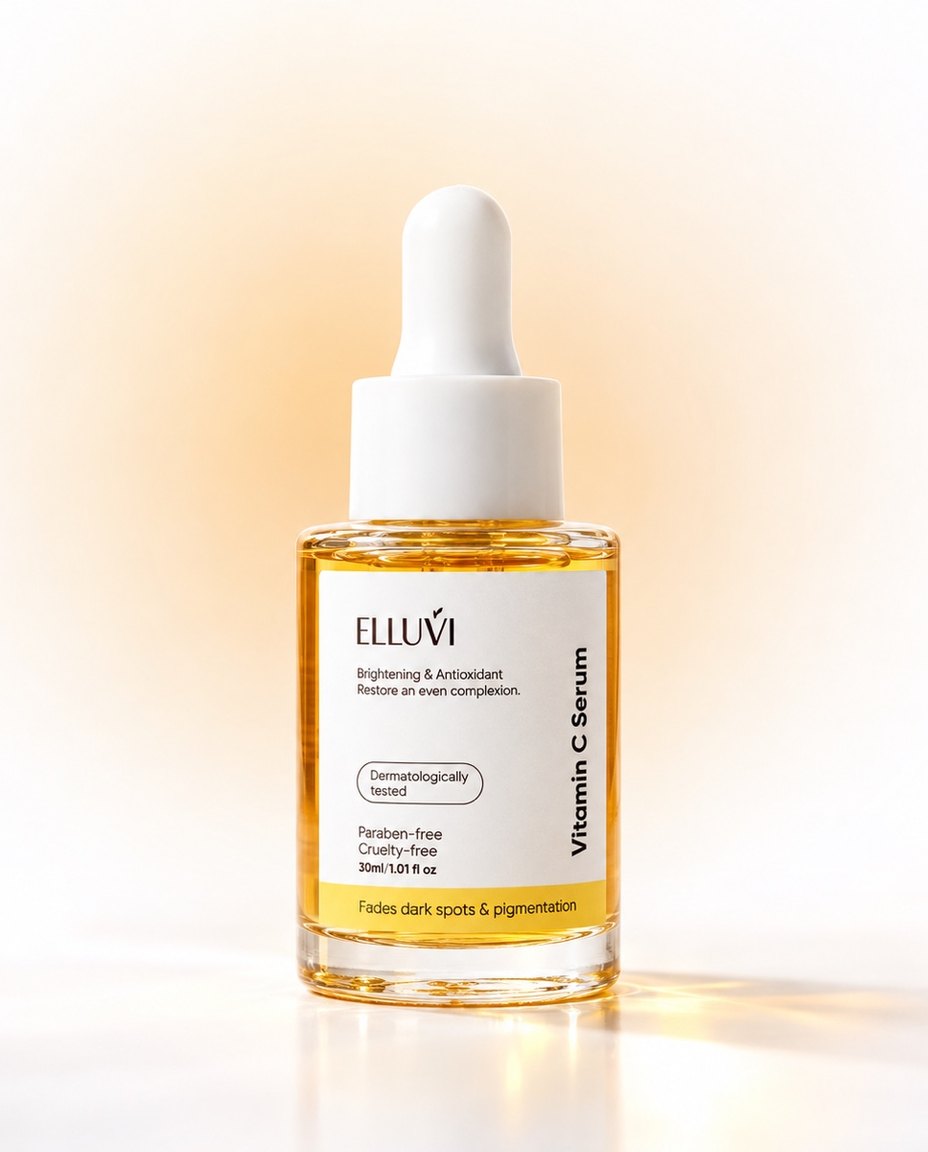
Sunscreen is not currently sold by Elluvi. Use a broad-spectrum SPF 50 from a trusted brand every morning. Elluvi Vitamin C Serum at Rs. 1,299 for 30 ml pairs with it in the morning — the antioxidant reduces the damage UV causes, and the sunscreen reduces how much UV arrives.